
Traffic circles are comparable to Disneyland.
Ellen Rogers
Kicker
In St. John’s, some Newfoundlanders call them loop-de-loops.
Roundabouts have become common in the city, but some drivers do everything they can to avoid them.
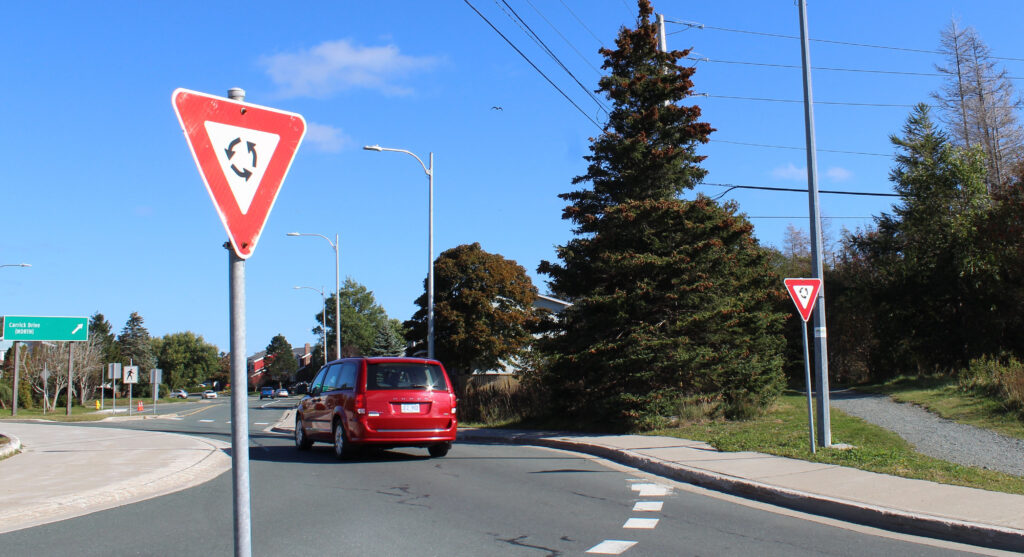
On Aug. 10, three new roundabouts opened in the city linking Heavy Tree Road, Robert E. Howlett Drive and Pitts Memorial Drive.
Additionally, the Portugal Cove Road intersection now features a single-lane roundabout connecting Portugal Cove Road, Major’s Path, and Airport Heights Drive.
It opened in September and remains under construction.
St. John’s Coun. Kate Cadigan says roundabouts are appearing more frequently. The idea, she says, is mainly to improve safety.
She explained the city’s traffic division, which manages road safety, uses police report data to identify areas with high collision rates.
The intersection at Portugal Cove Road is one of the most problematic, she says.
“Roundabouts are actually safer,” said Cadigan.
The Town of Paradise introduced St. John’s first modern roundabout in 2014 at Kenmount Road and Karwood Drive.
Most other Canadian provinces began adopting roundabouts in the late 1990s. Their popularity spread throughout the early 2000s. As a result, Newfoundland and Labrador was somewhat late to embrace this trend.
Driving instructor Glen Strang of Smart Driver’s Training says roundabouts are “the best thing since the divided highway”, and compares them to Disneyland.
Like Disneyland, he says, they are designed to move large numbers of people. But if one to two cars don’t know what they’re doing, traffic naturally backs up, creating chaos.
Since roundabouts are relatively new to the region, the government had to establish clear legal guidelines for their use.
These new rules were added to the written portion of the Class 5 driver’s exam. However, whether drivers have to navigate through a roundabout during the road test depends on where they take it. In the metro region, the road test includes roundabouts.
In some rural Newfoundland communities, such as Stephenville or Marystown, drivers only encounter standard intersections rather than roundabouts.
Meaning that during the physical exam, drivers aren’t required to demonstrate roundabout navigation skills or knowledge of the associated rules.
For young drivers from rural communities they may never experience a roundabout until they end up in the St. John’s region.
Currently under the province’s motor registration rules, if a person’s licence has been expired for less than five years, they can renew it without taking any written, vision, or road tests.
Renewal within this timeframe simply requires completing a questionnaire and paying a fee. Depending on age, licence class and medical conditions, they may also need to submit a medical form.
Strang says it’s the veteran drivers who can struggle.
“If you take somebody who has had their licence for twenty-plus years, is from around the bay, and isn’t used to city traffic (let alone newer additions like roundabouts), it only takes one or two cars to fool up the flow,” said Strang
He believes that when something new, like roundabouts, is introduced to the province, it should be required for drivers to be physically evaluated every five years or so to ensure they understand the changes.
Not only for their safety, but for the drivers around them.


Be the first to comment