
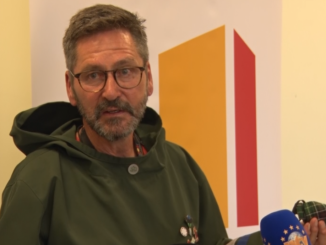
Deon Slaney said St. John’s is more accessible to blind people, but there is work to do.
Ellen Rogers
Kicker
Deon Slaney was legally declared blind at 20 years old. But his vision problems began much
earlier.
At the age of four, he was diagnosed with a rare eye condition called retinitis pigmentosa.
The specific type, X-linked retinitis pigmentosa, is inherited genetically. Females typically do
not develop the disease but instead act as carriers.
Slaney said that his mother is a carrier and that, at 75, she has never needed glasses, despite
passing on the gene.
He grew up in a small town on the Burin Peninsula. At 19, he moved to St. John’s for college and
quickly learned to adapt and navigate on his own.
He briefly took an electronic service technician course focused on fixing TVs and VCRs.
He finished two semesters before realizing it wasn’t a good fit. The work gave him
severe headaches and his condition was only getting worse.
He now works for the Canadian National Institute for the Blind. Over the past decade,
he’s seen major improvements in St. John’s, especially around accessibility and
inclusion.

For years, the CNIB would reach out to the city for help. Now, city officials come to them for expert
advice, marking a significant shift in how it approaches accessibility.
Still, he says there’s always more work to do.
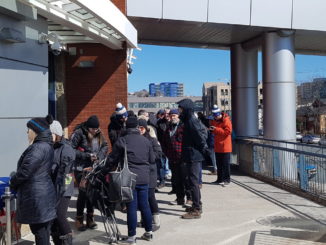
Slaney has navigated the city for decades and has grown used to it. His main challenge now is
winter, snow piled up on sidewalks by plows.
He doesn’t use a service dog, but said that people who do face challenges because service
dogs are trained to walk only on sidewalks.
Councillor Lynn Hammond, the city’s lead for inclusion, says St. John’s has worked on a detailed inclusion
plan for the past three years. She expects more progress in the coming year.
One upcoming development, for example, is the introduction of audible programs on metro buses. These programs will signal to passengers when and where the next bus stop is.
There is no date yet for when this electronic service will be installed, as the
software is still being developed.
Hammond said some areas of the city can clear sidewalks faster than others, depending on the neighbourhood. “There’s not a single solution where we’re going to make all the sidewalks clear,” she said.
Still, she says the city committed to improvement and recognizes the gravity of this issue.

Be the first to comment