
Adam Case of Bay Roberts is among the first people in North America to receive a rare eye surgery that involves removing a patient’s tooth before sewing it into the lining of the cheek. Later, the tooth is fitted with a lens and implanted into the patient’s eye socket.
Noah Johnston
Kicker News
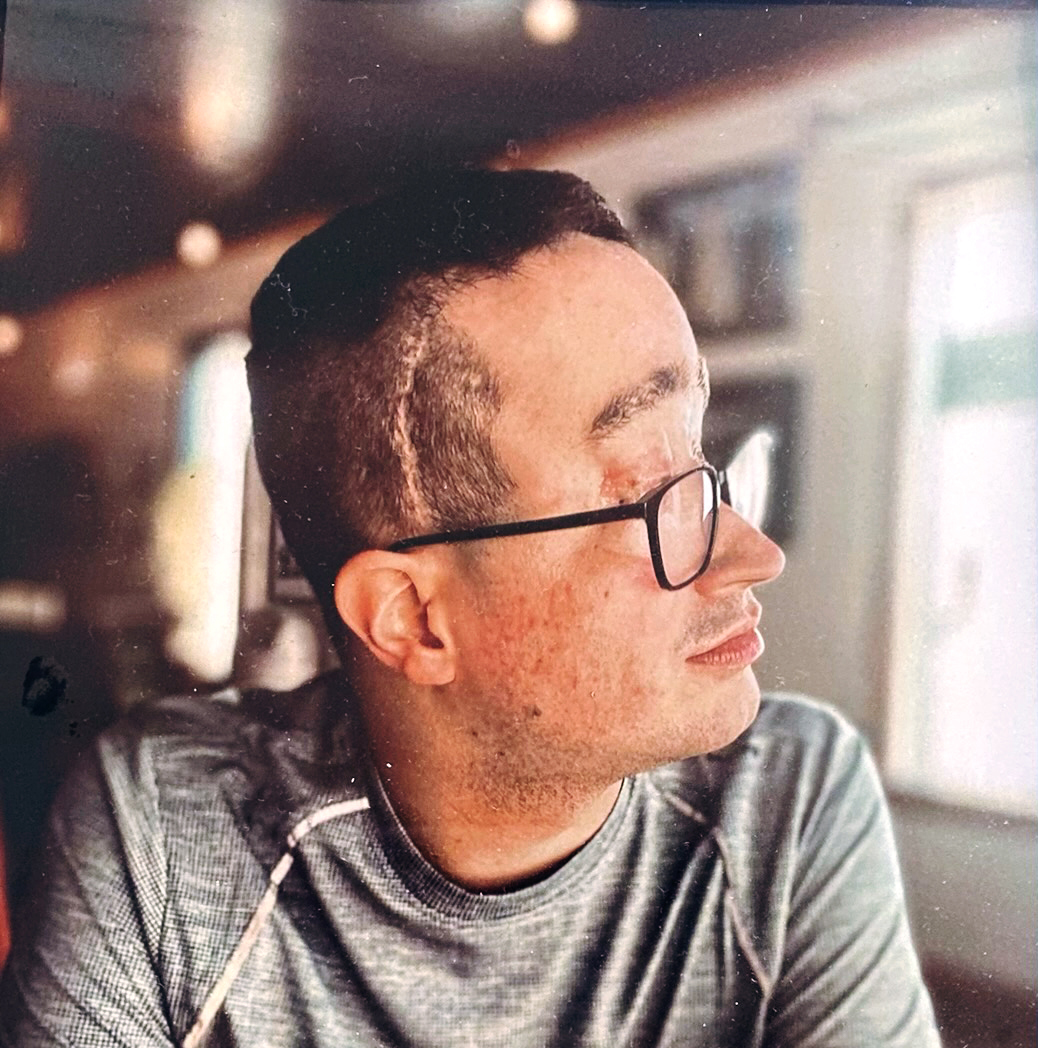
In 2020, Adam Case received some bad news. For the first 30 years of his life, he had dealt with poor vision stemming from a genetic condition. Now, his corneas were beginning to thin and perforate.
Without intervention, he faced losing the remaining vision he had.
Much of Case’s next five years were occupied with trying to treat his condition. He faced a flurry of procedures aimed at helping him keep his sight. Eventually, he lost track of the number of corneal transplants he had received — roughly 10.
Still, nothing seemed to take.
Facing rejected transplants and large amounts of built-up scar tissue, Case’s specialist suggested he try something different.
“Of course I was on board,” Case said. “The alternative to this was, pardon the pun, pretty dark.”
In a bid to save the vision in his right eye, Case was referred to Dr. Greg Moloney, a physician in British Columbia whose team was the first in Canada to offer osteo-odonto-keratoprosthesis, or OOKP — a procedure more commonly known as “tooth-in-eye” surgery.
OOKP is a rare surgical procedure. Case believes he is among only a handful of people in North America to have received it. It involves removing a patient’s tooth before sewing it into the lining of the cheek, where the tooth develops a layer of tissue and a blood supply. The tooth is then removed, fitted with a lens and implanted into the patient’s eye socket.
It is a complicated procedure involving many sub-surgeries and preparatory work to ensure a smooth recovery. Because of this complexity, the surgery is typically reserved for patients with large amounts of scar tissue buildup, autoimmune disorders or other complications. The procedure is suitable for people with these conditions because the tooth, already wrapped in tissue, is unlikely to be rejected by the body and acts as a solid frame for the lens replacing the cornea.
Even if the surgery was to be a good fit for Case, there were practical issues to consider. Constant trips from the Case family home in Bay Roberts to Vancouver were going to be costly. He would also need assistance and rest while recovering.
Case and his family set about raising the funds they would need to ensure everything went smoothly.
A hurricane of small local events and social media fundraising ensued. By the time Case began to travel back and forth for initial surgeries, the fundraising efforts had mustered around $45,000.
“It’s been helpful. We’ve had three emergency trips up here,” Case said. “It’s been quite beneficial to us. The community showed up in a big way.”
Case received the final transplant earlier this month. While his vision has not fully recovered, he appears to be healing well.
He and his father, Gordon, are hoping to head home to Bay Roberts soon to finish his recovery.
Niche procedure
Dr. Shaun Rideout, an optometrist in St. John’s, says few people receive OOKP because several criteria must be met for the surgery to even be necessary.
Patients who have one or more factors that make ordinary corneal transplants impossible, alongside the fully functional optic nerve required for OOKP to work, are quite rare. Such extraordinary combinations mean the procedure is likely destined to stay somewhat niche.
“It’s a very uncommon condition,” Rideout said. “I’ll say, most people simply won’t get to the point of needing that particular tooth-in-eye surgery.”
Although the prerequisites for tooth-in-eye surgery are rare, Case still wants people to know about the chance he received to save his sight.
“Outside the working-life preserving aspects of this, I’m glad that I get to do this because if one more person knows about it, then there’s one more person who can check to see if they qualify. One more person who doesn’t have to be a shut-in. One more person who can fully participate in public life.”

Be the first to comment